

Coach John Wooden is widely regarded as the finest coach in the history of college basketball in the United States, thanks to his peerless record winning ten NCAA championships in twelve seasons, including seven titles back-to-back and four perfect seasons without a loss. His impact transcended the sport of basketball and his ideas and coaching philosophy have been applied not only across sports, but in multiple realms from the medical profession to business leadership. Coach Wooden is no longer with us but his methods and philosophy were studied extensively, leaving us with plenty of relevant insights that are especially pertinent to kids who aspire to compete at the college level and beyond. Here we will highlight the key tenets. While they are aspirational, we will also explore how coaches and parents might tailor our approach to help cultivate the relevant attributes.
Most famously, Coach Wooden distilled his experience and insights into the ‘Pyramid of Success’, describing fifteen traits and behaviours existing in a hierarchical arrangement that represent the essential ingredients for sporting excellence. The elements within each row serve as the foundations and preconditions for the row above, such that the pinnacle of the pyramid ‘competitive greatness’ is the culmination of all the elements that it sits atop. The arrangement within each row is also intentional, as each respective element is connected to those that sit next to it. The pyramid has been described as a construction made up of fifteen blocks and ten pieces of mortar (the connections between adjacent elements).
Before we move on, it is worth dwelling on Coach Wooden’s definition of success, which is for the athlete to be able to look back with satisfaction knowing that they gave their best in the effort to become the best they could be.
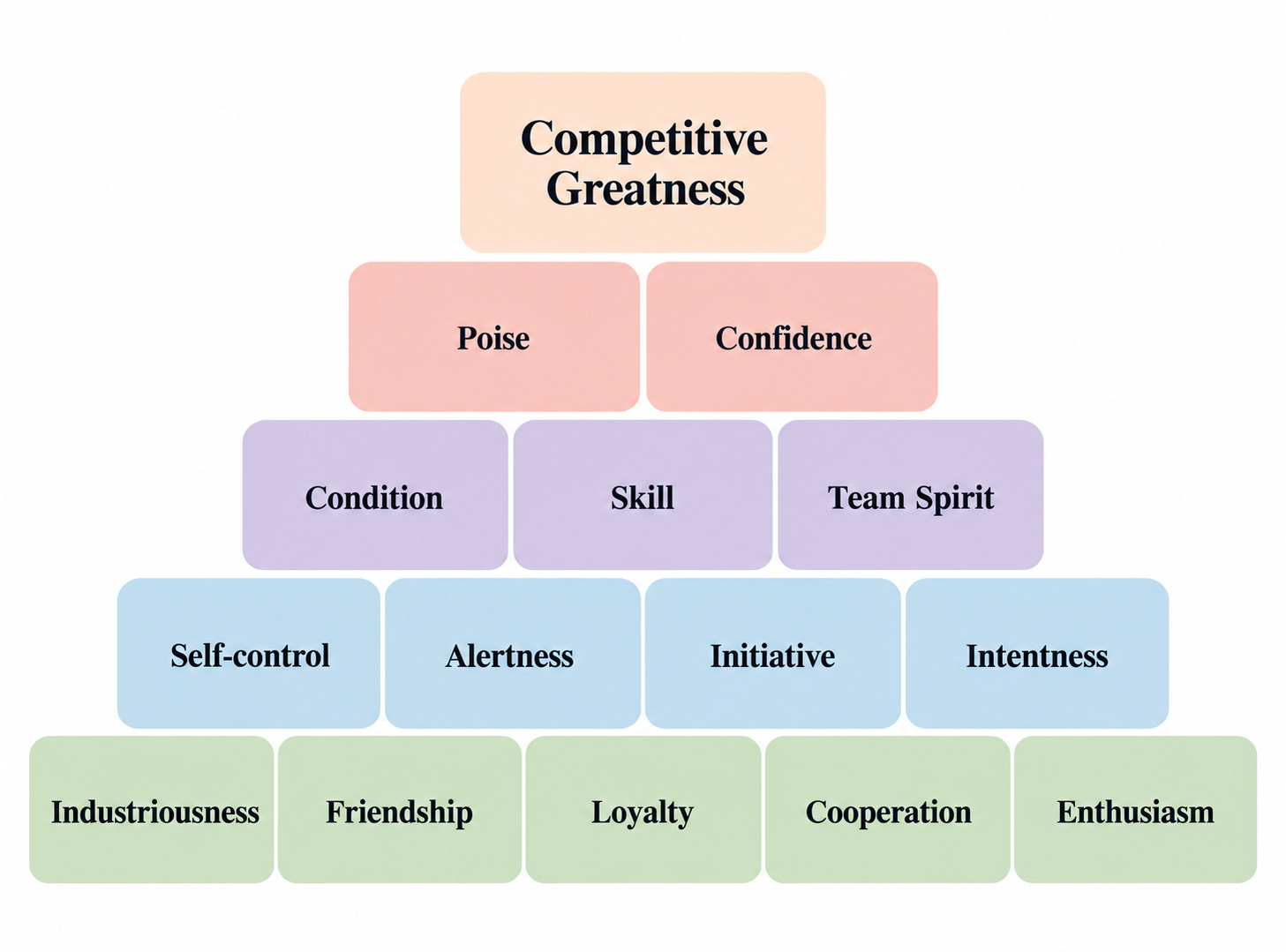
Helpfully, a 2014 study undertook the task of connecting the tenets of Wooden’s Pyramid of Success to the relevant sports psychology literature. As a result, we are able to better define the elements that are more opaque in terms that are more relatable and easily understood. The authors also explored the connections between adjacent elements in the pyramid to confirm whether there was empirical support for the relationships between the respective components.
Competitive Greatness Propensity to rise to the challenge and perform when it matters
Poise Calm, control and ability to respond effectively under fire
Confidence Well-founded belief that you are up to the task
Condition Being physically and mentally prepared to perform and compete
Skill Possessing tactical knowledge, technical capabilities and ability to execute in competition
Team spirit Sense of duty and willingness to sacrifice for the group
Self-control Able to exercise discipline and sound judgement in thoughts and actions
‘Alertness’ Observant, attentive, able to focus and resist distractions
Initiative Readiness to exercise agency, make decisions and take action independently
‘Intentness’ Concentration and commitment to the objective
Industriousness Planning and hard work towards a goal
Friendship Mutual esteem, respect and camaraderie
Loyalty Staying true to yourself and others
Cooperation Working well with others towards common goal
Enthusiasm Genuine and contagious love for what you are doing
The pyramid of success has direct value as it specifies and helps to define what aspiring student-athletes will need to bring to the party if they want to excel in their endeavours (as an aside, I would also add curiosity, as described in a recent article).

As well as offering a route to realising their potential in competitive sport, the model can equally be applied to other competitive arenas beyond sport, offering a blueprint for scholastic success and excelling in their chosen profession. The question that is not answered is how we might help aspiring student-athletes to cultivate the attributes identified.
To help bridge the gap, another group sought to apply and operationalise Wooden’s pyramid of success in teaching and coaching practice for youth sports. As well as helping to develop coaches’ teaching skills, the objective was to direct coaching practice in youth sports towards developing the elements identified. In other words, the ‘pyramid of teaching success in sport’ detailed in the article was an attempt to describe how we might conduct ourselves in a way that serves to realise those outcomes. In a sense, this becomes our definition of teaching success - i.e. the measure of our effectiveness as coaches of student-athletes is the extent to which we develop the relevant qualities described in Wooden’s original pyramid of success. As noted by the authors, these principles are equally applicable to teachers and parents of student-athletes.
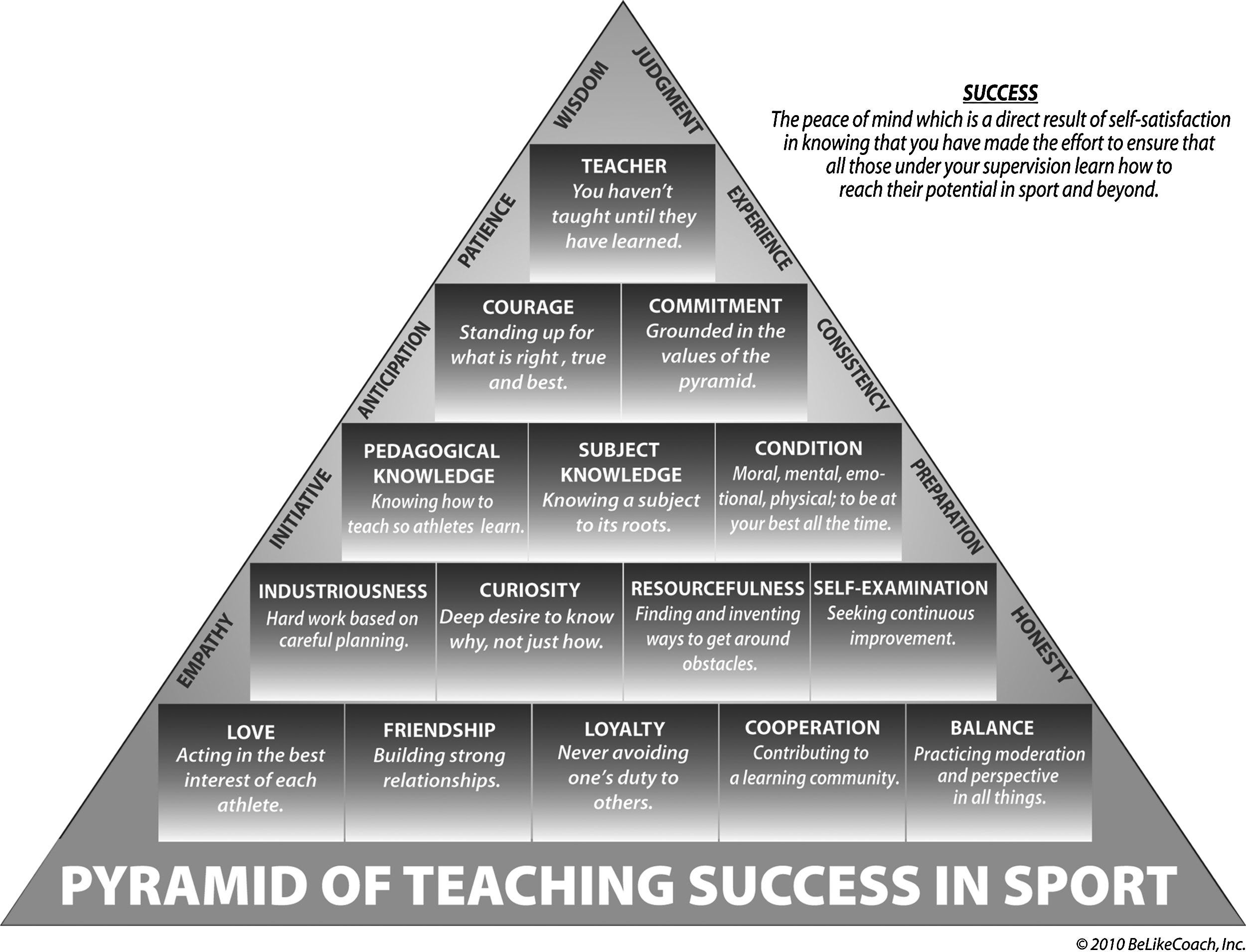
The Pyramid of Teaching Success in Sport also has fifteen elements. As in the original, these elements are ordered and placed in a hierarchical arrangement, with each row serving as the basis for the row above and related elements positioned adjacent to each other. The pyramid of teaching success is essentially a mirror of the original and features some of the same elements. In addition, the model describes the qualities that enable the coach to attain the components of each row moving up from the base of the pyramid. These are described as the mortar upon which each successive row is built.
The base of the pyramid is described as the foundation of teaching success. The cornerstones are ‘love’, defined as dedication and selflessness, and ‘balance’, in the sense of exercising moderation and maintaining perspective. The middle blocks emphasise the importance of the relationship (albeit I might quibble with whether ‘friendship’ is the proper term), loyalty towards those we serve and cooperation, recognising that we are part of a community and the necessity of collaboration.
The elements featured in the next tier are industriousness (careful planning and hard work), curiosity, resourcefulness and self-examination. The heart of the pyramid is deep subject matter knowledge, in combination with an understanding of teaching and learning, along with the duty to keep ourselves in good condition, such that we are able to operate at our best and model the lifestyle choices that support high performance. All of this is enacted through initiative and preparation - i.e. engaging in inquiry and self-directed study to fill gaps in our knowledge and develop our coaching abilities.
The penultimate tier defines courage and commitment as essential attributes. Courage encompasses integrity and conviction. Essentially, part of our duty of care is to speak the truth and do what is right in service to the athlete, irrespective of the consequences. Commitment pertains to upholding values and principles as well as maintaining standards, both in relation to the athlete and how we conduct ourselves. These elements stem from being consistent and acting with forethought and regard to the bigger picture.
The apex of the pyramid is the culmination of all the elements in the preceding rows and is described in terms of acting with wisdom and practising sound judgement. Rather than being an end point, it is an ongoing practice - as for athletes, mastery has no end point but is rather a pursuit (there are always things to learn and areas to improve). This recognises that the pyramid will remain a work in progress, as there will always be elements that we need to attend to and improve upon.
What really stands out to me is how much of this framework depends on the adults surrounding the athlete. We spend so much time asking whether kids have the discipline, confidence, and commitment to succeed, but perhaps we should spend just as much time asking whether we're creating the conditions for those qualities to develop. That's a conversation more youth sports families need to be having.